
On supermarket shelves, beautifully packaged chocolates quietly exude an enticing aroma. But have you ever wondered—how do these silky, rich desserts transform from humble cocoa beans into the intoxicating flavors we hold in our hands?
Today, let’s step into the heart of modern food industry and uncover the beauty of science and craftsmanship behind the industrialized chocolate production process.
While different brands and companies innovate in details (such as handcrafted refinement and emphasis on single-origin flavors), the core processes of large-scale chocolate production are highly standardized. Here is a typical complete industrial chocolate manufacturing process:
- Cocoa Bean Processing: Freshly harvested cocoa beans typically contain pulp, impurities, and even moldy particles. Therefore, the first step in industrial production is sorting and cleaning. Optical sorters and vibrating screens remove foreign matter, ensuring the purity of the raw materials. This is followed by drying and roasting. Roasting is a crucial step: roasting at precisely controlled temperatures (typically 120°C–140°C) triggers the Maillard reaction, releasing the aroma molecules unique to chocolate—the starting point for the “chocolate flavor.” Cocoa beans from different origins (such as Ghana, Ivory Coast, and Ecuador) require individual adjustments to roasting parameters due to variations in soil and climate, in order to preserve their unique flavor characteristics.
- Pressing and Shelling: After roasting, the brittle outer shell of the cocoa beans loosens and enters a shelling and winnowing system. The outer shell is separated, leaving the oil-rich core—the “cocoa chunks” (Nibs). These chunks proceed directly to the next stage: grinding.
- Grinding into a Pulp: From solid to flowing “cocoa liquor.” The cocoa chunks are ground for an extended period using high-precision stone mills or ball mills. The cell structure is broken down, and the cocoa butter gradually separates, ultimately forming a thick, warm, dark brown liquid—cocoa liquor (non-alcoholic). This process not only alters the physical form but also further refines the flavor compounds, laying the foundation for subsequent blending.
- Separation and Extraction: Cocoa liquor is separated using a hydraulic press. The pressed product is pale yellow cocoa butter, with a fine texture and a melting point close to body temperature. It’s the key ingredient that gives chocolate its “melt-in-your-mouth” characteristic. The remaining solids are pulverized into cocoa powder, widely used in beverages and baking. In chocolate manufacturing, most of the cocoa liquor is returned to the blending process, combined with additional cocoa butter to control the final product’s texture and flowability.
- Blending and Mixing: Cocoa liquor, sugar, whole milk powder (for milk chocolate), emulsifiers (such as soy lecithin), vanilla extract, etc., are added in a large horizontal mixing tank in specific proportions and thoroughly mixed into a homogeneous chocolate mixture. The proportions at this stage are extremely precise, directly affecting sweetness, smoothness, and market positioning.
- Refining and Tempering: The chocolate mixture is then fed into a refining machine. This process further reduces particle size, evaporates excess moisture and acidic odors, promotes flavor fusion, and results in a smoother, more rounded texture. Modern high-speed refining technology can achieve the same meticulous results as traditional slow processing in a shorter time. Tempering: This is the “magic step” that ensures the stability of the chocolate’s appearance and taste. Through precise temperature control programs (e.g., heating to 45°C → cooling to 27°C → reheating to 31°C), cocoa butter crystallizes into the most stable β-type crystals.
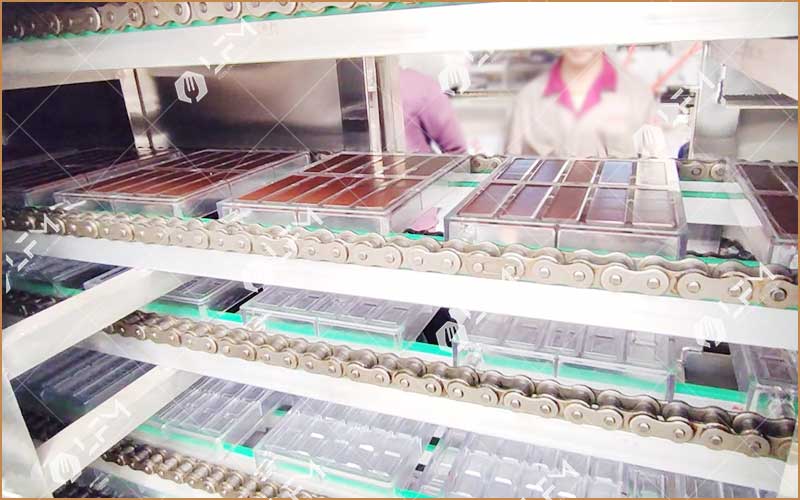
- Shaping and Packaging: After tempering, the chocolate flows into molding molds, is vibrated to degas, and then solidifies in cooling tunnels before being demolded into standard-shaped chocolate bars, egg-shaped gift boxes, or filled candies. Finally, after a series of automated quality inspection and packaging processes, including metal detection, weight checks, automatic bagging, labeling, and coding, the product is ready for distribution!
The industrial processing of chocolate is a precise concerto integrating agriculture, chemistry, mechanical engineering, and sensory science. Every seemingly simple piece of chocolate embodies countless technological innovations and quality control from the field to the factory.