
Industrial chocolate manufacturing machines represent a critical investment for any business looking to produce chocolate at scale. These specialized systems are engineered not only for high-volume output but also for speed, precision, and repeatability—qualities essential for meeting commercial demand while maintaining product consistency. From raw ingredient handling to finished, packaged chocolate products, each machine plays a distinct role in the production line.
The chocolate production process involves several key stages, beginning with the transformation of raw cocoa beans into a usable mass. Industrial equipment supports each of these steps: cracking and winnowing the beans, grinding them into a thick paste (often called cocoa liquor), combining that paste with sugar, milk powder, or other additives, further refining the mixture, and finally shaping the chocolate into bars, drops, or custom molds. Advanced machinery ensures that variables like temperature, mixing speed, and particle size are tightly controlled throughout.
Below is a closer look at the industrial chocolate-making equipment we offer, along with how each machine adds value to your production line:
Ball mill
Our ball mill serves as the first major step in creating a smooth chocolate base. By continuously agitating the cocoa solids, sugar, and any added flavorings with steel balls inside a temperature-controlled chamber, the machine reduces particle size to well below 30 microns—the threshold where chocolate feels silky rather than gritty on the tongue. The integrated cooling function prevents overheating, which can otherwise burn delicate cocoa butter and ruin flavor. This makes our ball mill suitable not just for dark chocolate, but also for milk and white chocolate recipes.
Conche
Once the ball mill has produced a fine powder-particle paste, the conche takes over to develop flavor and texture. Conching is a slow, heated mixing process that can last anywhere from a few hours to several days, depending on the desired outcome. Our conche uses variable-speed paddles and precise temperature zones to remove unwanted volatile acids (which cause bitterness), evenly distribute cocoa butter, and coat every solid particle in fat. The result is a smoother, more aromatic chocolate with a consistent melt-in-the-mouth feel. Thanks to our energy-efficient drive system and automated cycle programming, you can achieve these results while lowering electricity use per batch.
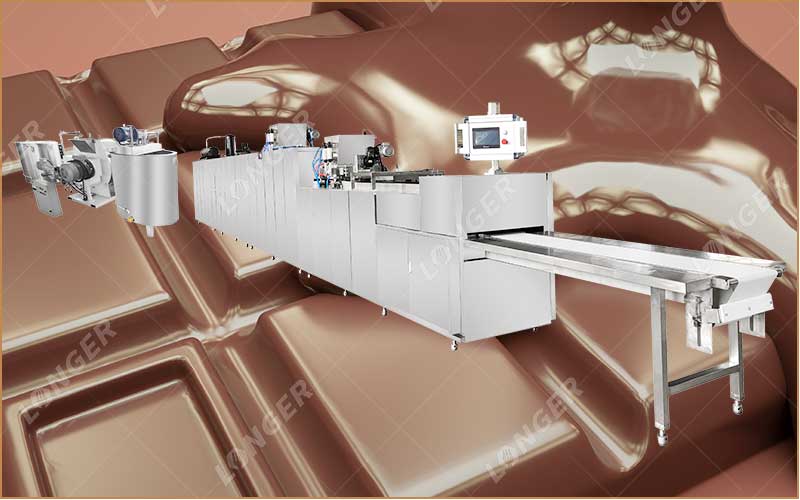
Chocolate molding machine
After conching, the liquid chocolate must be formed into its final shape. Our chocolate molding machine automates what would otherwise be a slow, labor-intensive manual process. It accurately deposits a metered amount of chocolate into each mold cavity, vibrates the molds to remove trapped air bubbles, and then transfers the filled molds onto a cooling conveyor. The system can handle different mold sizes and shapes—from standard bars to hollow figures or filled pralines—without requiring lengthy changeovers.
Enrober
For businesses that produce chocolate-coated products, our mini-enrober offers a space-saving yet highly effective solution. The machine creates a continuous “curtain” and bath of tempered chocolate, through which centers like nuts, caramel bites, or freeze-dried berries pass on a wire mesh belt. A blower system removes excess coating, ensuring an even, thin layer without pooling at the base. Despite its compact footprint, the mini-enrober delivers professional results—smooth coverage, proper snap, and no streaking. Its stainless-steel construction and quick-release parts make cleaning fast and hygienic, a key advantage when switching between different coating types or flavors.
Cooling tunnel
Following the enrobing step, the coated products need to be cooled rapidly and uniformly to set the chocolate correctly. Our cooling tunnel uses a combination of forced air circulation and precisely zoned temperature control—typically starting with moderate cooling to avoid “bloom” (fat or sugar crystallization on the surface) and finishing with colder air to fully harden the shell. The tunnel’s modular design allows you to adjust belt speed and cooling intensity based on product thickness and throughput. Rapid yet controlled cooling not only improves the glossy appearance and snap of the chocolate but also reduces the amount of floor space and time required compared to static cooling racks.
While industrial chocolate machines are most commonly associated with large-scale factories producing tons of chocolate per day, they are by no means out of reach for smaller operations. Artisan chocolate makers, boutique confectioneries, and small-batch producers are increasingly adopting compact versions of this equipment—such as our mini-enrober and benchtop ball mill—to boost output without sacrificing handcrafted quality. Scaling up with the right machinery allows small businesses to fulfill wholesale orders, enter new retail channels, or simply reduce overtime labor.
If you are ready to take the next step—whether you are outfitting a new production line or adding a single piece of equipment to an existing setup—please reach out to us. We can discuss your current capacity, product types, and growth plans, then recommend a machine configuration that fits your space, budget, and production goals. Our team is here to answer technical questions, provide reference videos or case studies, and help you avoid common pitfalls when moving from manual to mechanized chocolate making. Contact us today. Email: riva@machinehall.com | WhatsApp: +8618638675956