
If you were to ask a chocolatier, “Which step in the cocoa bean processing journey is the most important?” many would answer: fermentation. But if you were to ask, “Which step truly transforms the cocoa bean into chocolate?” the answer would undoubtedly be: roasting.
Prior to roasting—even after undergoing fermentation and drying—the cocoa bean’s interior remains in a state of “slumber.” It is roasting that awakens it, fully releasing the aromatic compounds and flavor precursors hidden deep within its cells.
Before Roasting: The Cocoa Bean Is Still “Asleep”
After fermentation and drying, the moisture content of the cocoa beans drops to around 7%. At this stage, the beans emit faint notes of acidity, fruitiness, or even a vinous aroma—yet they bear absolutely no resemblance to the familiar scent of chocolate we know and love. If you were to bite into a raw cocoa bean, you would encounter a distinct bitterness and astringency; the texture is dry, hard, and rather unappealing.
At this point, the cocoa bean is, in reality, “not yet chocolate.”
What Happens During the Roasting of Cocoa Beans
As the cocoa beans enter the roasting equipment, the temperature gradually rises to between 120°C and 150°C (the specific temperature depends on the bean variety and the desired flavor profile). At this stage, a complex series of chemical reactions begins to unfold:
- The Maillard Reaction—The Cornerstone of Aroma
Amino acids and reducing sugars interact under high heat to generate a vast array of aromatic compounds. This reaction is the source of those delightful “toasty” and “baked” aromas found in roasted, fried, and baked foods. In the context of cocoa beans, the Maillard reaction contributes warm flavor undertones—such as nutty, bready, and caramel notes. - Caramelization—The Source of Sweet Aromas
The naturally occurring sugars within the cocoa beans undergo caramelization at high temperatures, producing sweet, fruity, and even slightly bitter notes. This reaction enriches the cocoa beans’ flavor profile, adding depth and complexity. - Acidity Reduction—Rounding Out the Flavor
Raw cocoa beans contain relatively high levels of acetic acid and other volatile acids. During the roasting process, the high heat causes a portion of these acids to evaporate. This explains why, after roasting, the acidity of the cocoa beans is significantly diminished, resulting in an overall flavor that is more balanced, rounded, and mellow. 4. Moisture Evaporation — Becoming Brittle
Roasting further reduces the moisture content of cocoa beans to approximately 2–3%. With this reduction in moisture, the bean shells become dry and brittle, while the nibs shrink and their internal structure becomes more porous. This lays the foundation for the subsequent processes of crushing, winnowing, and grinding. - Enzyme Inactivation — Halting Fermentation
While fermentation is beneficial during the raw bean stage, its continuation into the storage and transport phases can lead to flavor spoilage. The high temperatures of roasting kill residual microorganisms and deactivate enzymes, thereby “locking in” the cocoa beans’ flavor at its ideal state.
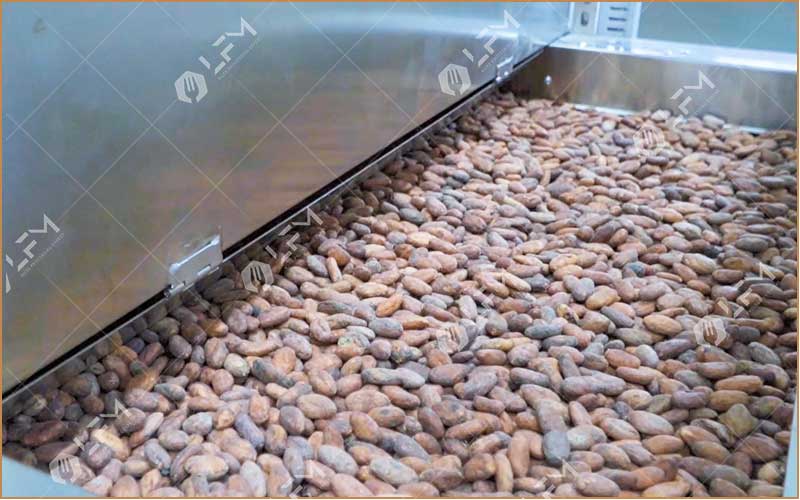
Roasting Level Determines Final Flavor
Roasting is not merely a matter of “cooking until done”; rather, it is an art form requiring precise control. Different roasting profiles can steer the very same batch of cocoa beans in entirely different flavor directions.
Selection and Considerations for Roasting Equipment
In actual production, the roasting process presents several core challenges:
- Temperature Uniformity: Uneven heating of the beans can result in a single batch containing both over-roasted and under-roasted elements.
- Process Controllability: It is essential to be able to precisely set and monitor the temperature profile.
- Batch Consistency: The results from the first batch and the n-th batch should be highly consistent.
- Energy Consumption and Efficiency: Roasting is one of the most energy-intensive stages in cocoa processing.
Post-Roasting Cocoa Beans: Transformed
Once roasting is complete, the appearance of the cocoa beans undergoes a distinct transformation:
- Their color shifts from light brown to a deep reddish-brown (darker roasts will appear nearly black).
- The outer shells become dry, brittle, and easy to peel away.
- A rich, intense chocolate aroma wafts forth—this is the first moment the beans truly “smell like chocolate.”
- Their texture changes from dry, hard, and astringent to crisp and brittle, with a porous internal structure.
At this stage, the cocoa beans can officially be classified as “roasted beans.” Next, they will proceed through subsequent stages—such as crushing, winnowing, and grinding—moving step by step toward their final forms as chocolate or cocoa powder.
If a high-quality bean is roasted improperly, all the effort invested in its earlier stages is significantly undermined. Conversely, an ordinary bean, when subjected to just the right roasting process, can reveal a surprisingly impressive character.
This is the allure of roasting—and its responsibility.