
Have you ever bitten into a piece of high-quality dark chocolate and wondered about its journey? That smooth, rich flavor starts far away on a tropical cacao farm, inside a large, colorful pod. Transforming raw cacao beans into the chocolate bar you know and love is a fascinating industrial art form. While making chocolate at home is possible, large-scale production involves precision machinery and careful scientific control.
How to make chocolate from cocoa beans? Let’s take a deep dive into the step-by-step industrial process of turning humble cacao beans into finished chocolate.
Step 1: Roasting – Unlocking the Flavor
The journey begins with raw, fermented cacao beans. Before any flavor can be released, the beans need to be roasted. Industrial manufacturers use large rotating drum roasters to heat the beans.
Roasting serves two critical purposes:
- Developing Flavor: The heat triggers the Maillard reaction (the same process that makes bread crust and coffee taste amazing), which unlocks the deep, complex chocolate notes.
- Reducing Acidity: Roasting helps evaporate unwanted acetic acid, resulting in a smoother, less bitter taste.
Step 2: Cracking & Winnowing – Separating the Gold
Once the beans are roasted and cooled, they move to the cracking and winnowing stage. A cracking machine breaks the beans into small pieces, loosening the thin outer shell (the husk) from the inner meat.
The next step, winnowing, uses air flow to blow away the lighter, unwanted husks. What remains are cacao nibs – the pure, crunchy heart of the cacao bean. These nibs are packed with flavor, antioxidants, and approximately 50-55% cocoa butter.
Step 3: Grinding – Creating the Cocoa Liquor
The pure cacao nibs are gravity-fed into heavy stone grinders or steel grinding mills. The friction and pressure generate heat, melting the fat naturally present in the nibs. Within minutes, the nibs transform from a crumbly solid into a thick, flowing, dark brown paste.
This paste is called cocoa liquor (or cocoa mass). At this point, the product is pure, unsweetened chocolate. Note: despite the name, “cocoa liquor” contains zero alcohol.
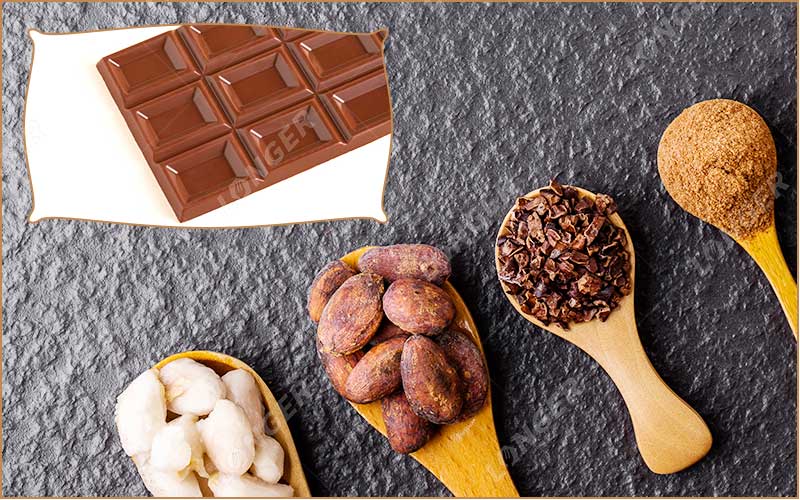
Step 4: Pressing – Separating Butter from Cake
Now the process can take one of two paths. For making chocolate, we focus on the cocoa liquor. However, in large-scale production, the liquor often goes through a hydraulic press.
Under extreme pressure the press squeezes out the fat. This rich, golden fat is cocoa butter, which is stored for later use in chocolate making or cosmetics. The hard, defatted block left behind is cocoa press cake. That cake is ground down to produce standard cocoa powder for baking.
Step 5: Mixing – The Recipe for Different Chocolates
This is where chocolate types are born. Manufacturers weigh and mix precise ratios of cocoa mass (the original liquor), sugar, and milk powder (for milk chocolate) in large mixing machines.
Step 6: Conching – The Secret to Silkiness
This is arguably the most important step for quality chocolate. The mixed paste is transferred to a machine called a conche (named for its shell-like shape).
Why is conching crucial?
- Texture Reduction: It grinds down any remaining solid sugar and cocoa particles until they are too small for the human tongue to detect
- Flavor Smoothing: It allows volatile, sour acids to evaporate and coats every solid particle with cocoa butter, resulting in a melt-in-the-mouth sensation.
- Homogenization: It evenly distributes the cocoa butter throughout the mixture.
Step 7: Tempering – The Crystal Clarity
Even after conching, the chocolate isn’t ready to be a shiny bar. If you simply let the liquid chocolate cool, it would set with a dull, grayish-white bloom (fat bloom) and have a crumbly texture. This is because the cocoa butter crystals have formed randomly.
The Final Step: Molding & Enrobing
Once perfectly tempered, the liquid chocolate is ready for its final shape. It is pumped into molds to create solid bars. After a final cooling tunnel chills the chocolate, it is demolded, wrapped, and shipped to you.
Want to Start Your Own Chocolate Production?
As you can see, modern chocolate making requires specialized machinery for roasting, cracking, grinding, conching, and tempering. If you are interested in setting up a complete chocolate production line, from bean to wrapped bar, professional equipment is essential to ensure consistency, texture, and flavor.
For more information on full chocolate production lines, industrial equipment, or technical support, feel free to reach out:
Email: riva@machinehall.com
WhatsApp: +8618638675956